Lover of nature, color, art, life, adventure. Choosing to find beauty. I hope you can find inspiration and joy while you're here.
Showing posts with label Sketchbook. Show all posts

11.01.2015

Alphabet Birds Part V

As tribute to the fantastic fowls of North America, I worked on an alphabet series of bird illustrations last month. I drew one bird for every letter of the alphabet. Here are illustrations Q-T:


Quail, Red-tailed Hawk, Scrub Jay, Thrush

I loved the variety of birds in this alphabet series, but I think it's totally possible to do a similar set of shore birds, birds of prey, mountain birds, or even prairie birds. Loved it!

10.25.2015

Alphabet Birds Part IV

I was inspired by the amazing fall bird migration to focus on bird illustrations for the month of October. I thought it would be a fun way to showcase the variety of birds by picking one bird for each letter of the alphabet. It's been difficult to choose just one kind for each letter because there are so many amazing birds to pick from. But, I managed to narrow my pickings down to North American birds and narrowed it further by mostly sticking with birds I have seen.

Part IV of the bird series shows off birds M-P:


Magpie, Nighthawk, Osprey, and Peregrine Falcon

I could do a thousand million of these, I'm pretty sure, because of the variety of birds to pick from, and all the different quirky stances and silhouettes. Guys, I just love all the birds. (Yes, even pigeons.)

10.18.2015

Alphabet Birds Part III

As part of my focus on birds for the month of October, I've been sharing a series of North American birds for every letter of the alphabet on my Instagram account. It's been exciting to learn about each type of bird, and I couldn't help but share a fact along with each illustration. Sharing the fascination, guys. Sharing the fascination.

These next four are Ibis, Jay, Killdeer, and the Long-eared Owl:


Stay tuned for the next set of four, and spread the fascination for nature!

10.11.2015

Alphabet Birds Part II

Here are the next four birds (E-H) of the alphabet bird series I'm doing in the month of October:


Eagle, Flicker, Great-horned Owl, Heron.

I've enjoyed drawing these illustrations in my sketchbook and sharing a little fact about each kind of bird along the way. Nature is so fascinating! Stay tuned for the upcoming illustrations or check out my Instagram account for the daily updates, where you can request to see an illustration of your favorite bird.

10.04.2015

Alphabet Birds

As a tribute to the amazing bird migration (and for Feather & Fir's namesake--birds are the best!) I've been drawing a North American bird for every letter of the alphabet. During the month of October I'm posting them on Instagram along with a quick fact about each highlighted bird, so be sure to check them out here on the daily.

Birds are so marvelous to me! It's fascinating how as a group they can seem so similar, but once they're examined a little more closely their distinct personalities and unique features shine. Each little species contains a wonder all its own!

Here is a recap of the first four illustrations, just in case you missed them:


Thanks for stopping by today! If you'd also like to see what our family is up to, you can follow our tomfoolery on my personal blog, here.

12.14.2014

New Sketchbook

I'm not easily excitable, but there is one thing guaranteed to make me giddy on any day: a new sketchbook!


Not only does a new sketchbook represent all the progress I just completed, but it also opens the door wide for incoming inspiration. I pretty much love everything about a new sketchbook from the smell, to the crisp feel of the pages. Nothing is as exciting to me as a book full of blank pages! Fresh starts, directional changes, style exploration...so many things feel optimistic. The opening of the cover marks a new era, and anything is possible...hooray!

Do you feel the same way? What is one way you mark fresh starts in your goings-on?

11.09.2014

Behind the Scenes: Mistakes

So, we all know the internet tells lies all day long. It fibs about people and their lifestyles and it has this knack for making people feel less than they are. It proposes ridiculous expectations and stretches the reality of actual real life by showing only the sparkliest of sparkles. One reason for such glittery goodness, though, is to project professionalism, which isn't necessarily a bad thing. Being selective about the content and making it more beautiful (or highlighting the found beauty) isn't anything to be ashamed of.

However, I was pondering this very topic the other night and as I was flipping through my sketchbook realized that it might be interesting to see the all-too-truthful context regarding an  Instagram post from a few weeks ago.

And this is what that sketchbook page looks like in its entirety:


(I threw in the messy counter as a little peek into my reality. You're welcome, extra bonus. Obviously I have better things to do with my life than keep that huge counter spotless all the livelong day.)

As you can see, the little doodle I posted was not my first attempt. And, it also wasn't a finished piece of artwork by any means. It was even doctored up a little to increase the contrast. And it still wasn't perfect. I mean, take a close look at that "N", would you?

However, it was still the best out of the few attempts I took at doodling this phrase. The other two took a skiwampus turn for the worse and had to be abandoned. So, mistakes. They happen. You can either get dejected and turn it into a huge deal or you can study it and improve the next time. What I'm trying to say is that all those effortless photos that are plastered all over the internet may not be that effortless after all. More likely, hours of work as well as trial and error went into the production (and post-production, let's be real) of something beautiful, and you shouldn't expect immediate perfection from yourself or others without first encountering a few mistakes.

I'm not one to become easily discouraged when I make a mistake. Sure, it's embarrassing (darn typos!) but by golly, I'm human, so I do what I can and get over the rest. It's more of an means and less of an end, you know? Also, I feel relieved and trust people easier when they are real about their little lives. I always feel more at ease when I know someone is just a regular person after all.

Do you feel the same way? What do you think the difference is between editing + curating and living a life full of lies?

9.14.2014

4 Ways to Sketch, Part IV (Shapes)

On Instagram, I showed a sketch I had done of the same flower using four different techniques. I thought it would be helpful to dive into the types of sketching since each technique is used to hone in on different illustration skillz.

The last type of sketching is using basic shapes. This is the method I use to make my most realistic-looking pieces and allows for a little more evolution and correction than the other highlighted sketching techniques. Feel free to join in while we explore this type of sketching a little more:


First, you'll want to identify the main shapes that make up your subject. Imagine the subject as a bunch of geometric shapes with a sheet laid over them. Imagine the framework underneath the surface. Look for protrusions and curves, angles, and general shapes and lightly indicate them on your paper with a light touch:


Once you've identified the main shapes, connect them and go over them again, paying closer attention to detail with each pass. Draw over each line, still with a light touch, but correct shapes and angles you may have gotten wrong the first time around:


Repeat as many times as necessary, always refining the details and shapes you've already established. Keep a light touch the entire time, since the repetitions of your lines and shapes will naturally darken the lines and redefine the shapes. Continue until your corrected shape matches the subject. Notice and add in smaller details and shapes:


This type of exercise is ideal for learning how to notice the underlying skeletal structure of a subject. Knowing how to show that helps give your subject weight and volume. It is also a great platform to use if you're ready to start adding different values (tints and shadows) to your artwork.

This four-part series highlighted 4 of my go-to sketching methods and the illustration skillz they help develop. Did you find these how-tos helpful? If so, I'd love to know! Is there another sketching method you'd like to see? I'd love to hear what you think.

9.07.2014

4 Ways to Sketch, Part III (Contour)

On Instagram, I showed a sketch I had done of the same flower using four different techniques. I thought it would be helpful to dive into the types of sketching since each technique is used to hone in on different illustration skillz.

The third type of sketching is a standard contour. There are several ways to treat a contour sketch (like part II- continuous) but this is usually what comes to mind for me. Contour basically means an outline. Depending on the details of your subject matter, this can take a little or a long time, but you can decide how much detail you want to include. Care to join? Please do:


Before drawing, you'll want to identify the details closest to you and work your way out from there. I identified this set of petals that seemed foreshortened and the main perspective point. This is not to draw attention to that part of the drawing, since it will blend in once the drawing is completed, but it will be so much easier to draw (especially if using a pen without pencil sketching beforehand) if you know where to start:


Once you've laid down your starting point, begin working in the remaining details. The purpose for this exercise is to practice observation skills and line control. One thing to take note of when sketching using this method is to never intersect lines. Lines should touch other lines but never run through them.  Each artist is different, but I often like to include lines that appear in the subject but don't necessarily start and stop at other lines, such as wrinkles or folds:


Continue filling out the image, paying close attention to overlapping pieces and ensuring lines don't overlap:


I love how clean and light this type of sketching looks, and think it can make an excellent finished art piece if done correctly. Some people like to use this style for finished artwork, but I like to try my luck sketching this way with a pen.

So, what do you think? Do you like this kind of look? Have you done it before? I'd totally love to see!

8.31.2014

4 Ways to Sketch, Part II (Continuous)

On Instagram, I showed a sketch I had done of the same flower using four different techniques. I thought it would be helpful to dive into the types of sketching since each technique is used to hone in on different illustration skillz.

The second sketching method is what I like to call a continuous line drawing. It can have some silly results at first, but with more practice, the better things will look. The purpose behind this exercise is to help you learn how to gauge space and relative line placement. This isn't a timed exercise, and I like to do this slowly as I continually reference my subject and the nuances that my line quality is developing. I'd love it if you joined, so grab a pen and a paper and let's get started:


This exercise is a single continuous line, so pick a focal point on your subject and begin there. Since this technique doesn't lend itself to easy correction, plan out your space usage before laying your pen to paper. I started at the top of the tomato where the stem meets the fruit because everything seemed to radiate from that point for me. I used it to gauge how much space the sketch would take up and the relative placement of the features. Using that as my reference point, I drew the right side, paying attention to my subject for subtle dips and ridges so that I could reflect those nuances in my sketch:


Then I swooped around, making sure to represent indentations with loops. It's important to keep your entire arm and shoulder loose when you draw a continuous line. If you're only using your wrist, you're going to get little saw-toothed sketch marks. That is not what we are after. To keep the line as smooth as possible, you should use your entire arm in a slow and controlled manner. I like to imagine the movement originating from my shoulder or even my chest. It's not unusual for your upper body to move around in support of your pen, but the results can be unique and beautiful:


Loops and overlapping is totally cool and expected because this is a single line. This is an exercise in self-control, in achieving a smooth line quality, and in predicting the results of where you started with your scaling. Sometimes you'll realize immediately that your spacing is off, and sometimes you think it will work out until you get to the end and your lines don't match up as planned.

(A fun variation of this exercise is to draw your subject using a continuous line without looking at your paper at all. As soon as your pen touches the paper, you can only look at the subject. It helps you realize the difference between what the subject actually looks like and what you think it looks like.)

Have you done this exercise before? I love how effortless the final result can look, but it takes lots of self control to get to that point. It can be pretty funny if you're with friends drawing one another, but it also helps develop essential artist skillz. If you try this out, I'd love to hear how it went!

8.24.2014

4 Ways to Sketch, Part I (Gesture)

On Instagram, I showed a sketch I had done of the same flower using four different techniques. I thought it would be helpful to dive into the types of sketching since each technique is used to hone in on different illustration skillz.

The first in this series, and quite possibly the best for beginners is the gesture sketch. This is great for super fast sketching and embraces errors and allows for easy correction. I like to use this technique to capture images in two minutes or less because it really focuses on the gesture or movement of the subject. This is less about a finished piece of art and more of a warmup exercise to stretch those drawing muscles. Three-fourths of becoming a good artist is learning how to see and the rest is learning techniques to draw what you see. Perspective is everything, and this little exercise will allow for developing that ability to see things as they are and not as you imagine them to be. Want to learn how? Grab a pen and set your timer for 60 seconds to join along...


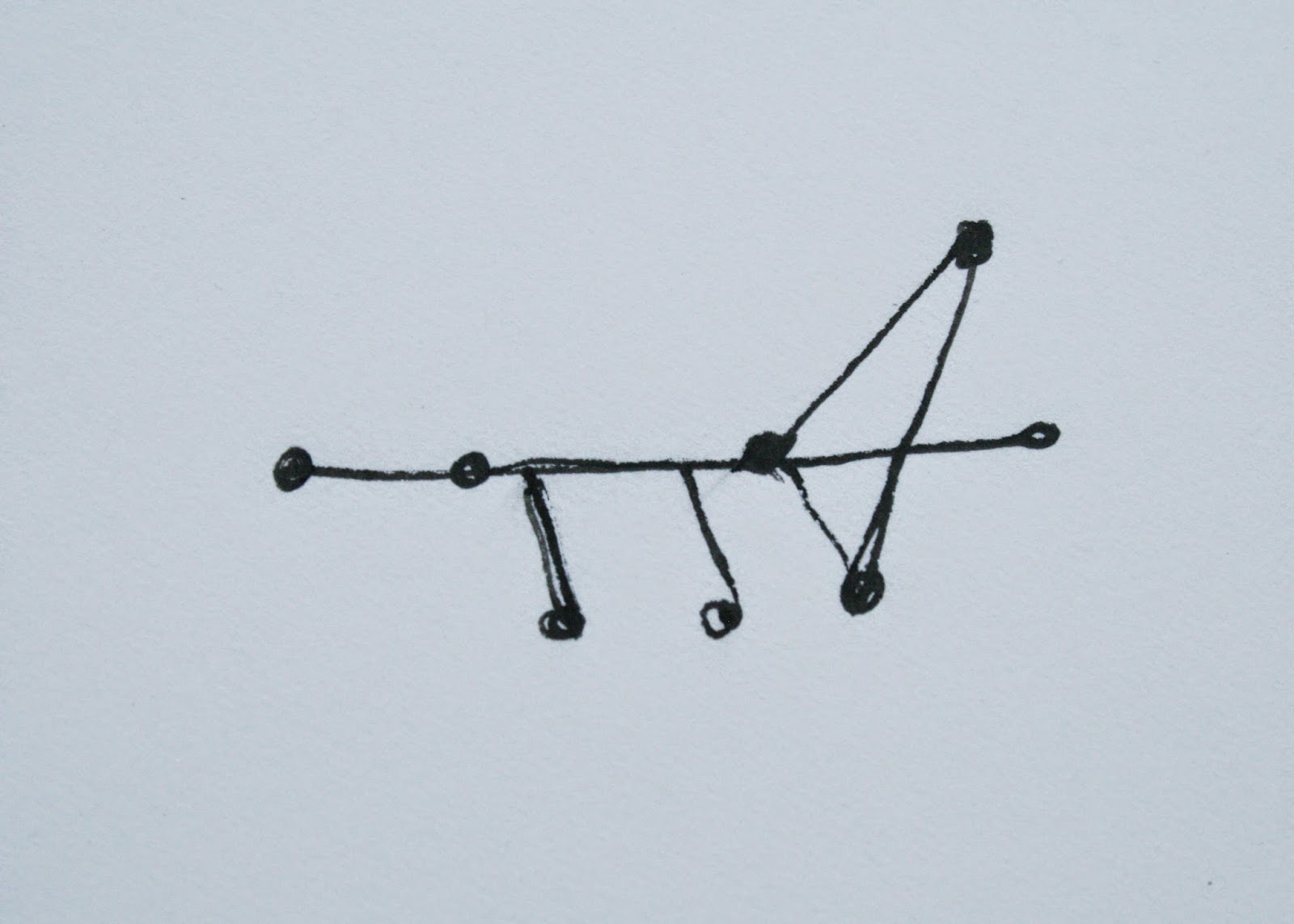
This technique is pretty much a controlled scribble, and is meant to be done super fast, like a ninja. Instead of just starting wherever, take a few seconds after the timer's started to glance over the subject. Begin by identifying the main points of your subject. You're not looking for volume or space, but are noticing the intersections of different appendages as well as the farthest reaching points. Once you've identified them, begin drawing. In this grasshopper sketch, I've drawn points at the head, thorax, end of the abdomen, and the legs:


Once you've started drawing, don't pause or lift your pen from the paper. That keeps you from lollygagging and helps you draw fast. Continue by filling out the lines with some snakey scribbles. The point it to get the general idea of space taken by the subject:


The trick is to get it as identifiable as possible in a short amount of time. Continue with your frantic scribbles to fill out that shape. You should be spending most of your time looking at your subject than at the paper you are drawing. Really look at your subject. Pay attention to the shape in general, then look at it again for a few more specifics, then look at it again with an even more detailed eye. Refine and redefine the shapes as you scribble, and if you have enough time, now you can concern yourself with volume:


You'll notice this isn't the prettiest sketch, and that's okay. It seriously took seconds. I didn't get all of the leg joints in before my time was up, the head shape is way off, and some of the angles are wrong. That's fine, this is not finished art.

This is a great exercise to do before sitting down and actually drawing for realsies. I like to do 5-10 subjects for a couple minutes each (or try 30-second increments if you really want to challenge yourself) to relax and settle into the practice of drawing. Doing this has probably helped me improve my observation skills the fastest out of any other drawing exercise I've done. The more comfortable you get with the quick format, the better you are at seeing subtle differences in angles and proportions sooner and the better the actual sketch will look after a while.

I'd love to know if you found this helpful or if you've already tried this. And if you've tried this, do you have any tips to add?

8.10.2014

Taking Every Opportunity to Improve Part II

As promised, I went back to the Bean Museum with my family. Thanks to Dreamguy and his incredible parenting skillz, I was able to get a few minutes (not just seconds!) to sketch some more creatures:


Yep, It's just like riding a bicycle. These things just got easier the more I did them. Now that this museum is finally open for realsies, I'm going to be spending some quality time there appreciating life and death and art and nature and my place in this world.

Is there a skill you've reawakened recently? If so, I'd love to hear and be inspired by your awesome self! And to see part one again, just to see how much one extra visit helped, go here.

8.03.2014

Taking Every Opportunity to Improve

I'm always looking for opportunities to improve, especially with my art skillz. That means that when appropriate, I will sketch during meetings, classes, church, or in between tasks at home. It means that any time I go on vacation or get a chance to stare at something long enough to jot a little representation down, I'll take my sketchbook along.

We recently went to the Bean Museum with that crazy youth group that I love so much and I took my sketchbook along for the ride. Don't judge, but what I'm about to show you are gestures only, not real or finished drawings by any means. I seriously only had seconds to complete a couple of these because our group was moving fast as lightning:


Gesture drawings mean I try to capture the general shapes and movement and not necessarily the detail. Drawing in pen meant I couldn't erase and redraw incorrect lines or shapes and that I had to draw over in order to correct and redefine the shapes. Admittedly, the first couple were pretty rough because it's been a while since I've tried timed drawings. Once I was able to gauge the timing a little better, though,  I was able to get more detail and essential shapes in before moving on. These sketches are in order of appearance in my book, and I can definitely tell a marked improvement as I flexed and stretched my dormant gesture muscles.

Moral of the story is that regardless of how much time you have, the important thing is to keep practicing. I'm planning on going with my family again soon and taking a little more time to refine my output. So, we'll see how that turns out next time. Wish me luck! Meanwhile, are there any tips you have on continual practice? I'd love to hear!