I recently completed a large painting and thought it might be interesting to show the process from start to finish. Read on, if you'd like to see all the nitty gritty details:
//Topic//
I always paint with something in mind such as an end goal or an experience I'd like to capture. The
church I belong to put out a call for submissions for an art contest, and in this case, the topic was assigned. The theme for the contest was "Tell Me the Stories of Jesus."
With a certain topic in mind, I got to thinking, which is something I'm pretty good at spending a lot of time on. I knew I didn't want to do a figure drawing because the majority of art pieces would probably be represented that way and I wanted to stand out a little more. I knew I didn't want to use a realistic art style and I knew I wanted to incorporate nature somehow because that's my thing. I knew I wanted to include symbolism to echo Christ's teaching style and use of parables and allow for flexible interpretations when others saw my art.
Because this was a tender topic for my heart (not to mention highly religious and therefore of a sensitive nature), I also prayed a lot and studied the four gospels in the Bible several times to narrow down my myriad options. I finally landed on a story that met my major goals but that I knew would also lead me down an artistic path that wasn't completely planned out ahead of time.
The story I selected to represent was Christ's Sermon on the Mount, and the teaching that struck me in particular is found in Matthew 6:
19 Lay not up for yourselves treasures upon earth, where moth and rust doth corrupt, and where thieves break through and steal:
20 But lay up for yourselves treasures in heaven, where neither moth nor rust doth corrupt, and where thieves do not break through nor steal:
21 For where your treasure is, there will your heart be also.
//Thinking//
With a topic and a theme to go off of, I then got to work thinking even more. Over a period of several months, I thought through all the details and arrived at a final concept. In the beginning, I wasn't sure how to represent heavenly treasures, but I liked the idea of a heart being
with the things that are most valued.
It reminded me of our family. We spend a lot of time outdoors, and my daughter and I both tend to collect nature things on our adventures then bring them home to display. The items end up on our pianos and shelves and on our mantel. I liked the idea of a fireplace mantel being the heart of a home. And, the more I thought about it, the more I realized that the things families value most are often displayed in an intimate yet central location, such as on a mantel, so they can be respected while also appreciated. I felt I had found an excellent foundation for 'where your treasure is, there will your heart be also.'
So, I began to make lists and sketches of intangible things that I find valuable.
//Initial Sketches and Evolution//
My first quick sketch was an attempt at including items that would feel like they were part of a naturalist's collection in a jar:
The naturalist concept felt a little forced to me, and while it had the potential to be beautiful, it wasn't very practical (like, how can a candle stay lit in a closed jar?) and it seemed a little too whimsical. However, I had a few items that I found I liked and was happy to include, and I began to realize the potential of the symbolism and the idea behind openly displaying what is important to my heart. I realized this was a successful way to echo the parable-style symbolism Christ used in his teaching.
So, I took a second stab at the sketch, using the same kind of concept, but without the naturalist twist and spread out a little more, to take up an entire mantel:
The composition felt much better to me, and I loved that the new way to display allowed for more items to be included and to be more equally represented. I had been having a difficult time deciding which metaphorically represented items should be the focal point because I found them all to be equally important in obtaining. I didn't want to have anything be partially hidden or unrecognizable.
Still, I didn't love the composition entirely, so over the period of many weeks, I sketched several more versions and continually tweaked the list of heavenly treasures, playing around with the shapes and composition, adding and removing items, as well as altering which items represented which values:
Feeling satisfied that I had a solid content, I moved on to the next phase.
//Style and Media//
I knew I didn't want to portray my art in a realistic style. I was leaning toward something more modern, like a continuous black contour line drawing on white paper. I also know my strengths lean more toward the drawing rather than the painting end of the art spectrum. Even though I have spent hundreds of hours in the last year practicing and perfecting my painting skills, I also knew that a large majority of artists in our church are well-known for their realistic painting style. I wanted to avoid blending in with the other contestants.
However, one problem I ran into was the way I wanted to represent 'forgiveness.' It's an extremely important heavenly treasure, both to me personally as well as in our church, and the way I could best think to portray it was with a ombre cloth, gradually changing from red to white. Color hadn't been a part of my original plan, so my initial intention of creating a simple continuous line contour wasn't an option any longer.
I considered merging the modern continuous contour style with a light watercolor wash, like an offset print, and tried out the style to see if it worked:
Even though it was only a quick pre-paint sketch, I didn't like the way it turned out. The colors were not intense enough for me, yet somehow distracting, and I didn't think the ombre affect on the cloth was apparent enough to warrant a watercolor wash behind each individual item. It seemed like a half-hearted effort instead of a gentle reinforcement. After a lot more thought, I opted to paint the entire art piece using watercolors in small sections, and using the same kind of detail technique I used to create
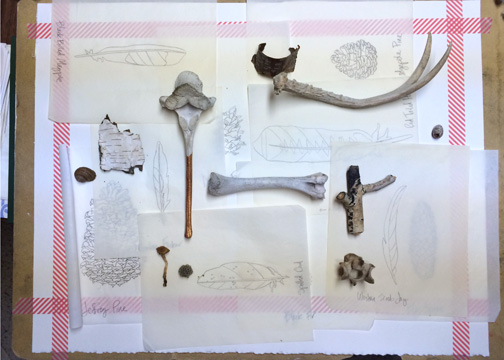
this forest cones watercolor series. I decided to treat the paint more like acrylic and less washy, like I would with a typical watercolor painting.
//Gather//
While I had most of the items I needed on hand, I still had to round up a few pieces as a visual reference. It took a while to hunt down everything I needed, and I went on several adventures with the sole purpose of gathering specific items. Luckily, though, in my hunt to find certain objects, I was able to make a few final tweaks to the items included in the painting while still maintaining the important values they symbolized. It all came together and helped me see where I needed to make additional changes to my lineup.
//Display//
As I gathered the pieces for my still life display, I also started assembling it. As I added items, I would rearrange the display. Over the course of several days, I arranged and rearranged the display in order for it to be visually appealing and to make sense compositionally. I even took it apart completely and put it back together during this time. I watched for issues like variety in height, having the colors well-balanced, and keeping a strong composition and kept rearranging until I was satisfied:

While it's important to have a visual reference, I used my display as just that, a reference. I did not exactly copy every single piece and texture found in my display. I knew I was going to change the colors, and some shapes, but I made sure each item was somehow visually referenced so that I could use it to occupy the space and study it more closely when sketching and painting my art piece. I needed a reference in order to ensure my perspective didn't change between items and that all my lines and shapes made sense for the viewer's eye.
//Paper Preparation//
While most fine art pieces are framed after they are created, I had a few large frames hanging around for such purposes, and I picked one that I liked for this particular project. I then re-sized my paper to fit within the selected frame, which wasn't too difficult. I simply trimmed a little off the edges of my paper. With my final paper size established, I then prepared my paper. First, I made sure I was going to be painting on the correct side of the paper. Then, I measured and taped off the edges:
The purpose of taping the edges is two-fold. First, it establishes clean boundaries and ensures the final artwork is centered on the paper. Second, when attached to a board, it keeps the paper in place and prevents warping.
//Sketch//
With my paper sized and placed on a large enough board, I got to work sketching.
I used a large ruler, a graphite stick, and an eraser. I began my sketch by briefly mapping out general shapes, like I showed in
this tutorial. I then went over my drawing multiple times, refining and adding details as I went along. I had some added help from my three-year-old, who often likes to sit on my lap and hold my hand as I draw or paint. So, once I had established strong contour lines and various details, I went through my entire sketch and cleaned it up. I erased all the smudges, I lightened the pencil lines because they can easily show through watercolors, and I checked to make sure there weren't any marks outside of my established tape boundaries because I needed that to stay as clean as possible. This is what my final sketch turned out to be prior to painting it in:
//Painting//
Next came the painting. Most watercolor paintings are built from the background to the foreground, but because I was treating this particular piece more like opaque acrylic paints, I could start on whatever object I wanted:
Once the initial color was laid down and dry, I erased as many pencil lines as I could so they wouldn't be a distraction. I made sure to use this painting order to balance my color usage, and I painted all the items in similar colors all at once to make sure I remembered how to mix my paints correctly. I also painted items in the same color simultaneously because it allowed me to work on one object while another was drying before adding more paint layers. Then I moved on to items in different colors:
I knew when I started that I wanted to keep the colors rich and stick to a classic triadic color scheme. Keeping that in mind, I used warm neutrals to support my brighter primary colors:
Once the initial color was laid down, I went over many of the elements again to add dimension, texture, and to smooth out the color:
I filled in every space, and painted multiple layers on each shape and element, adding slight color nuances to certain items, correcting painting errors as I went along, and ultimately achieving the richness and warmth I envisioned:
Next, I added the finishing touches.
//Finishing Touches//
Finishing touches included carefully and methodically reviewing the entire painting, examining every shape and line, and making final corrections. I corrected textures, cleaned up touching lines, added shadows, smoothed out colors, and added a few additional layers of paint. Once the painting was dry, I carefully removed the tape, cleaned up my edges, and signed that puppy! Complete!
//Submitting//
The artwork process isn't complete, though, until the work is submitted. I had been working on an artist statement throughout the entire process, from idea conception through signing my name. Here's what I wrote:
In the Sermon on the Mount, Christ taught to us to lay up heavenly
treasures that cannot be corrupted or stolen. Our spiritual gifts and
aspects of personal character are ours to hold, guard, and maintain by
carefully sharing and cultivating with intention. During his ministry,
Christ taught of many heavenly treasures we should seek to lay up in our
hearts. Each item displayed in the painting, while supposedly common,
is representative of one of the many treasures we can gather during this
life: Faith, the Light of Christ, Industry, Testimony, Forgiveness,
Savor, the Love of Christ, Wisdom, Fortitude, Peace, Improvement, the
Word of God, and Eternal Life. These items are shown on a mantel because
whatever we collect and display in our homes is usually a reflection of
what we choose to be most important in our hearts. Our gathered things
tend to be driving forces that motivate us and eventually become a part
of who we are. Everyday items placed with care can serve as a reminder
to focus on the important things we should cultivate. The variations of
goodness we collect and incorporate into our hearts may appear seemingly
simple, yet they hold the greatest value and are of the highest
importance. Through our everyday actions on earth, we can gather a trove
of heavenly treasures that can remain with us forever.
*Bonus for reading this far...in case you're curious and to test your guesses, the heavenly gifts represented are:
Faith--plant
Light of Christ--candle
Industry--honey
Testimony--oil
Forgiveness--ombre cloth
Savor--salt crystals
Love of Christ--stick of thorns
Wisdom--owl feather
Fortitude--antler
Peace--white rose
Improvement--mirror
Word of God--pearl
Eternal Life--pine cone
Also, I already knew the dimensions and other requested info, so once the painting was complete, I only had to take photos and send it along. It's such a good idea to do these little things ahead of time instead of scrambling when trying to meet looming deadlines. Framing and additional submission steps will be taken if the piece gets past the first round of jurying.
//Ta-da!//
And that's the process for this painting from start to finish. It represents months of work, and involved a lot of thinking, practice runs, and epiphanies. I loved it, though, and I'm pleased with the path it took, so it was definitely worth it to me.
So, what do you think? Worth the work? Questions on the process? Ponderings on the piece?